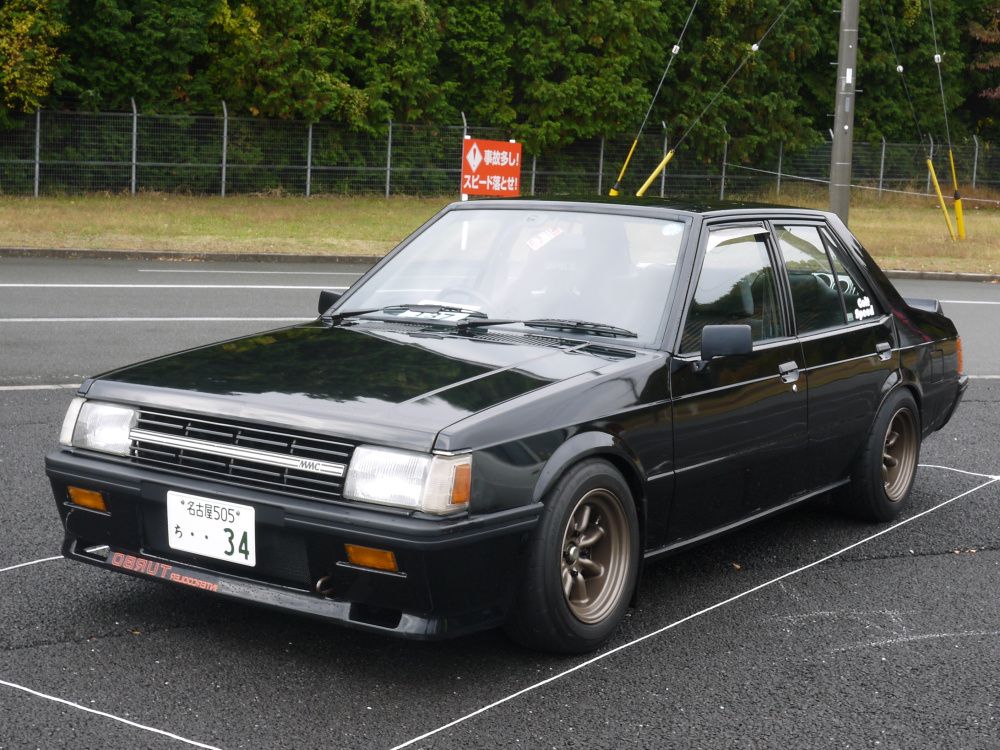
In 1979, the all new Lancer EX was unveiled in Japan. Its new, clean and aerodynamic styling with integrated plastic bumpers reflected that of the recently introduced Galant and Sapporo. It was of a more European appearance than earlier Mitsubishi vehicles.[9] Considerably more spacious, it grew in all dimensions.[9] Only two engines were offered at first, a 1.4-liter MCA-JET equipped engine paired with Mitsubishi’s Silent Shaft Technology, which generated 80 PS (59 kW) and a 1.6-liter engine that generated 85 PS (63 kW). The MCA-JET system was an entirely new concept when compared with the previously used carburetor system. The MCA stands for Mitsubishi Clean Air which meant that the EX passed both Japan and US emission standards, while the new cylinder head design of the engine gave way for a Jet valve which introduced an extra swirl of air to the combustion chamber, swirling the fuel-air mixture for a cleaner, efficient and more thorough burn.

Mitsubishi Lancer EX 2000 Turbo (Europe)
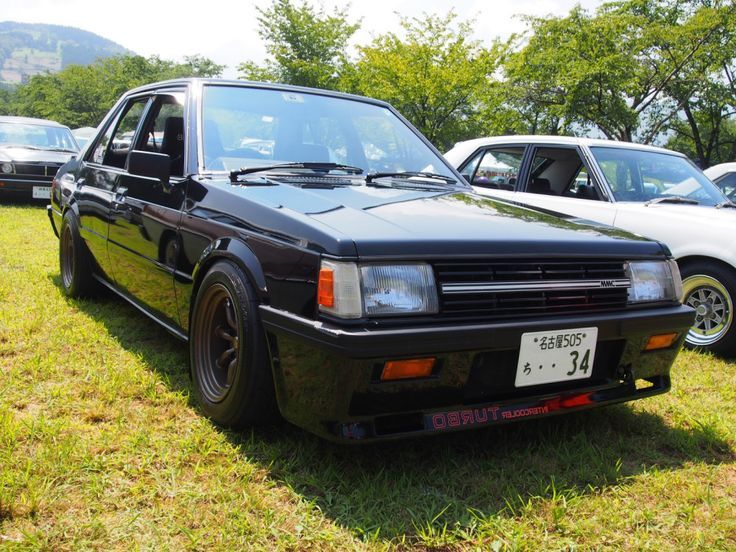
In addition to these improvements, another breakthrough in the Lancer lineup was the Silent Shaft Technology, which was actually two counterbalancing shafts that rotated in opposite directions, cancelling the power pulses inherent in an inline four-cylinder engine. This reduced both engine noise and vibration, and provided a smoother driving experience. The 1.8-liter Sirius 80 engines were then introduced in the Lancer in 1980, expanding the Lancer’s range of engines. Also, a turbocharged, 135 PS (99 kW) engine was added in 1980 for sportier performance, and an intercooler system was also integrated in the existing turbocharged engine to produce 160 PS (118 kW) in 1983.
In 1980, The Lancer EX was introduced with a 1.8-liter turbocharged inline-four option known as the 1800GSR and GT Turbo. The first generation 1800GSR and GT were only available with a turbocharged, non-intercooled 135 PS (99 kW).
New Zealand importer Todd Motors assembled the new Lancer EX from 1980 with 1.6-liter carburetor gasoline engine and a choice of manual or automatic transmission. The model was also a popular base for rally cars in that market, with some success. It was replaced by the front-drive Tredia in 1982 with the Cordia coupe equivalent effectively replacing the earlier Celeste.
EuropeEdit
In Europe, the Lancer EX sold well as its restrained styling better matched the desires of European buyers than its somewhat fussy predecessor. Other considerations concerned handling and also the demand for more passenger room, as Mitsubishi tailored the Lancer towards European consumers. It went on sale locally after making its European premier at the 1979 Frankfurt Show.[10]
Unlike in Japan, European buyers could also get a 1.2-liter option which suited local tax conditions. Claimed outputs in Europe were lower than in the domestic market, with the 1200, 1400, and 1600 being good for 40, 50, and 60 kW (54, 68, and 82 PS) respectively.[9] Here, the Lancer EX was also offered with a turbocharged 2.0-liter engine, known as the Lancer EX 2000 Turbo. It achieved a maximum output of 125 kW (170 PS) and managed a top speed of 200 km/h (124 mph). This model was equipped with multi point fuel injection(ECI). A rally version of the Lancer EX 2000 Turbo was made for the 1000 Lakes Rally that gave out 206 kW (280 PS). At home, sales of the turbo model were low because of emission regulations Japan imposed at that time.
JapanEdit
- 1400 SL, GL – Four-door sedan powered by a 1.4-liter engine, with a four-speed manual transmission; a five-speed was also introduced (1979–1987).
- 1200 EL, GL, SL – Same as the 1400, with a 1.2-liter engine option (1979–1983). The EL was the lowest priced version with very little equipment.
- 1400 GL A/T, SL, GLX – Three-speed automatic version with a Turbo, SL replaced GL in 1983 (1979–1987).
- 1600 XL – Four-door sedan powered by a 1.6-liter engine, with a three-speed automatic transmission (1979–1983).
- 1600 GSR – Four-door sedan powered by a 1.6-liter engine with twin carburetors, with a five-speed manual transmission (1980–1983).
- 1600 XL Super – Same as the XL, with minor changes (1983–1987).
- 1800 SE – Four-door sedan powered by a 1.8-liter producing 100 PS (74 kW) engine, and available with a 5 speed manual transmission or a three-speed automatic transmission (1981–1983).
- 1800 GSR Turbo – Four-door sedan powered by a turbocharged 1.8-liter engine producing 135 PS (99 kW), with aesthetic upgrades (1981–1983).
- 1800 GT Turbo – Same as the GSR, but with a different body trim (1981–1983).
- 1800 GSR Turbo Intercooler – Intercooler version of the first turbo version, producing 160 PS (118 kW), and with minor changes to the aesthetics (1983–1987).
- 1800 GT Turbo Intercooler – Same as the GSR Turbo Intercooler, again with different body trim (1983–1987).
- 1800 GSL Turbo – Same as the GSR Turbo Intercooler, only it used the engine from the GSR/GT Turbo, and equipped with a three-speed automatic transmission, and with a more luxurious interior along with an AM/FM multi-cassette stereo system (1983–1987).
EnginesEdit
4G63T
- ECI turbocharged SOHC 1997 cc inline-four, 170 PS (125 kW)
4G62/G62B
- ECI turbocharged SOHC 1795 cc inline-four, 160 PS (118 kW)
- ECI turbocharged (third gear) SOHC 1795 cc inline-four, 135 PS (99 kW)
- Carburetor SOHC 1795 cc inline-four, 100 PS (74 kW)
4G32/G32B
- Carburetor SOHC 1597 cc inline-four, 85 PS (63 kW)
4G33/G12B
- Carburetor “MCA-Jet” SOHC 1410 cc inline-four, 80 PS (59 kW)
4G11/G11B
- Carburetor SOHC 1244 cc inline-four, 54 PS (40 kW)
 Lancer Evolution Series